
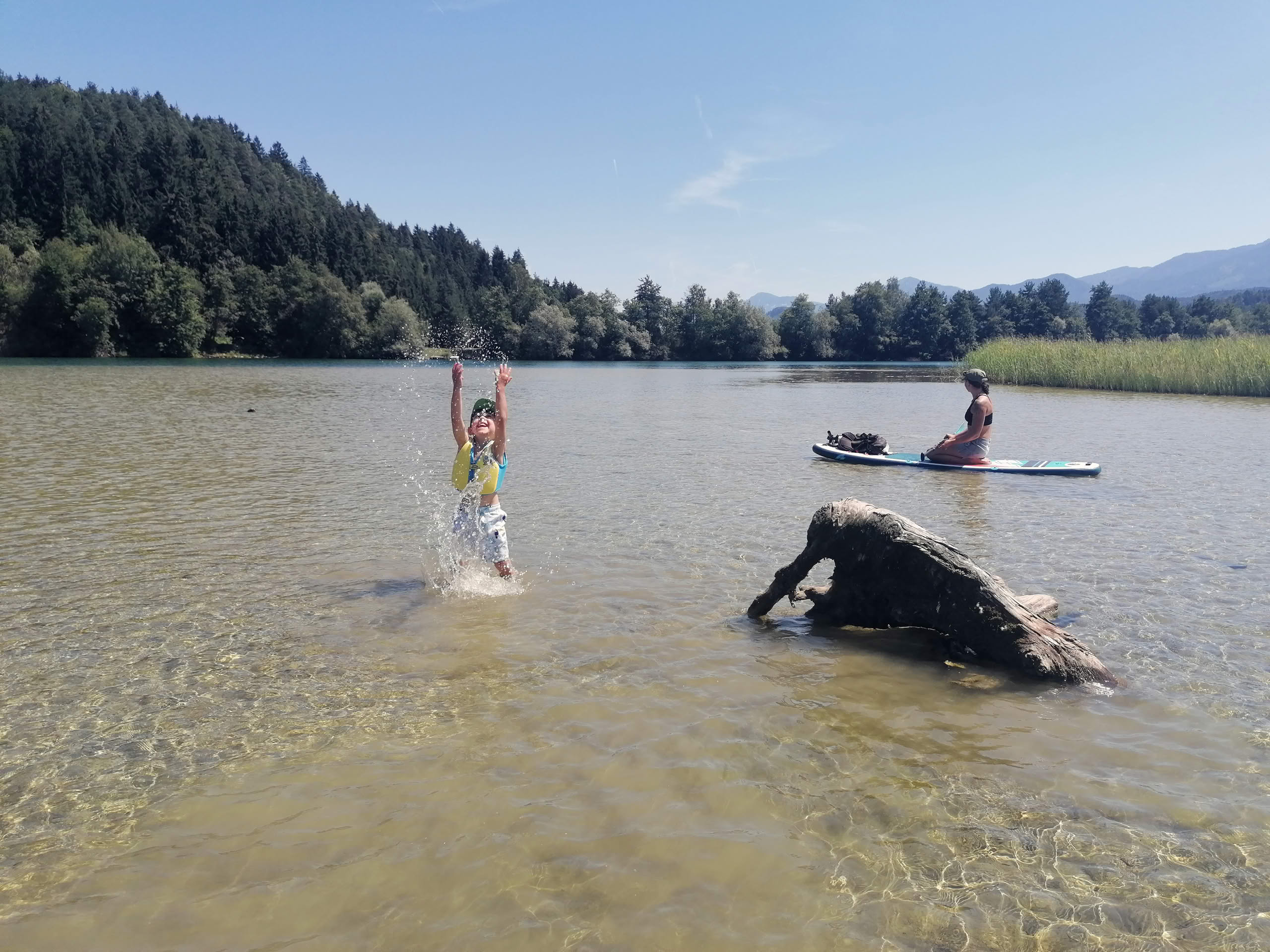
Stand-up paddleboarding is becoming increasingly popular among families. On the water, children experience a fascinating blend of adventure, physical activity, and direct contact with nature. For coaches, physical education teachers, clubs, and parents, however, the question arises of how this sport can be taught in a way that is safe, educationally sound, and age-appropriate.
Effects on Motor Skills and Developmental Psychology
Starting as early as age five or six, children can benefit from the diverse challenges of stand-up paddling, provided their basic motor skills allow it. The constant need to maintain balance on the moving board places high demands on the vestibular system and the body’s entire deep muscle system. The constant, subtle adjustments noticeably improve coordination and proprioception (depth sensitivity), while paddling also requires diagonal and rotational movements that promote balanced, bilateral physical development. Children can draw on and benefit from this physical and motor foundation even later in adulthood, which may help delay the onset of potential degenerative conditions.
Beyond the purely motor skills level, stand-up paddleboarding also has an impact on the cognitive and emotional levels, as children learn to continuously perceive their surroundings on the water — such as gentle waves, wind direction, or other paddlers — and respond appropriately. This constant adaptation not only trains their ability to concentrate and their spatial awareness but also strengthens their sense of self-efficacy, with successful moments — such as standing securely or executing a maneuver successfully — instilling pride and fostering frustration tolerance. In a group setting, social learning processes come into play as well, as children practice being considerate, supporting one another, and acting cooperatively.


Safety First
Safety is, of course, the bedrock of any sporting activity involving children, as drowning after a fall, hypothermia, sunburn, or unexpected collisions are the primary risks associated with SUPing. That’s why you shouldn’t skimp on equipment — it should be carefully selected. A well-fitting life jacket with at least 100 Newtons of buoyancy is essential and is ideally complemented by wearing a leash with a quick-release mechanism. This allows kids to use the SUP board as an island or a buoy in an emergency and can also be quickly released if necessary. Depending on the water temperature, wetsuits, rash guards, or neoprene socks provide adequate protection against the cold. In the height of summer, comprehensive sun protection is also important; however, we rely less on carcinogenic sunscreens and more on caps, hats, and, if necessary, long-sleeved shirts.
A favorable staff-to-child ratio of about 1:3 to a maximum of 1:4 allows caregivers to maintain an overview and respond quickly to individual needs. This means that one adult should supervise no more than three to four children in order to keep every situation under control. It is also advisable to have up-to-date first-aid training and, if possible, lifesaving certifications.
Before each SUP session, a thorough risk assessment of the water and a careful review of the weather forecast are essential. Especially for beginners, the wind speed should not exceed one Beaufort, since children (depending on their age and experience) may not yet have the strength to cope with wind and waves at higher wind speeds. This can consequently lead to fear or even panic, which in turn can trigger a cascade of poor decisions, falls, and accidents. It’s best to agree on a clearly defined emergency plan with the children in advance, including standardized signals and established procedures, as this provides structure and additional safety for the children even in unexpected emergencies.
The Right Equipment
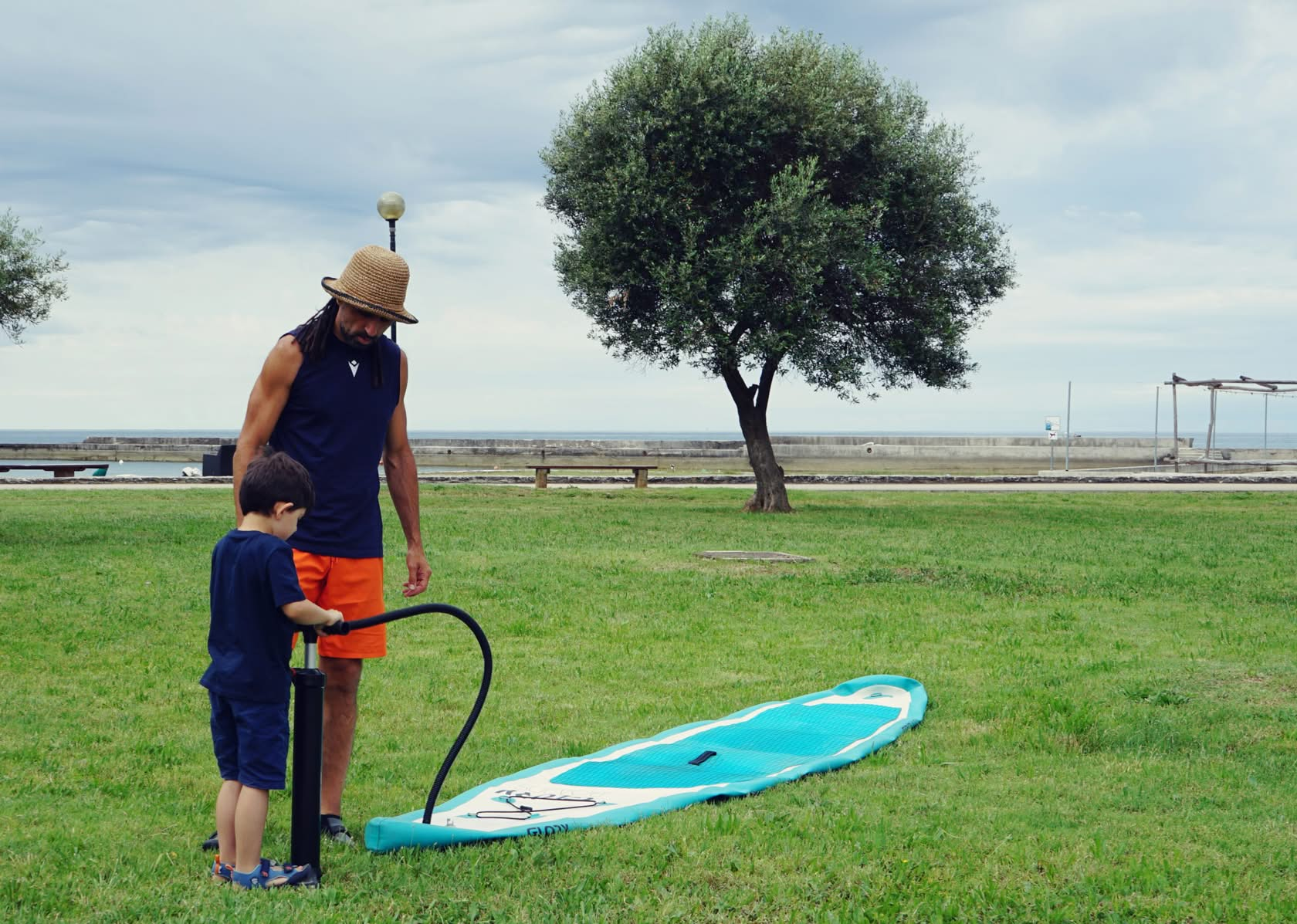
Choosing the right equipment is key to a successful SUP tour with children. Young paddlers benefit from wide, stable boards with a standing area of about 80 to 85 centimeters and sufficient volume. Inflatable iSUPs have proven particularly effective in practice, as they are easy to transport and pose a lower risk of injury in the event of a fall than hardboards. However, hardboards are the better choice for advanced children who participate in competitions.
Board lengths between 8’0” and 10’0” generally offer the best combination of stability and maneuverability, and the paddles should be height-adjustable and as lightweight as possible. Models made of carbon or fiberglass with paddle blades adapted for children make it easier to execute the technique correctly and prevent improper strain on the shoulders and spine. One disadvantage of aluminum paddles is that they can sink quite quickly after a fall, whereas carbon and fiberglass paddles float on the water’s surface for much longer.
Teaching and Pedagogy
Successful instruction in stand-up paddleboarding relies on a playful and step-by-step approach. It often begins with unstructured, free practice on the shore or in shallow water. Children first learn to maintain their balance while sitting or on their knees before slowly getting up to stand on the board. The basic paddling techniques — from the correct grip and the pull phase to simple turning techniques — are first practiced while stationary and later while moving. It’s important at every stage not to put pressure on the children and to prioritize exploration and experimentation over structured — and sometimes stressful — training processes. Too much pressure and ambition imposed by adults can not only spoil the children’s enjoyment of SUPing but also their enjoyment of sports in general.
Playful elements such as treasure hunts, obstacle courses, relay races, or simple yoga exercises on the board keep slightly more advanced kids motivated. While younger children between the ages of five and eight primarily need fun and playful exploration, older children — starting around age nine — can already handle longer tours and more refined techniques. Those who supervise multiple children (e.g., SUP instructors) should work in small groups, as this allows them to respond particularly well to each child’s individual developmental level and provide optimal support for every child.
Benefits and Practical Considerations
SUP has a wide range of positive effects on children’s development. Physically, children benefit from improved core stability, better coordination, and stronger deep muscles. These motor skill improvements often carry over to other sports and everyday life. The constant, subtle movements of the water promote sensory integration — an aspect that can be particularly beneficial for children with concentration difficulties or mild motor skill challenges. On a mental level, the direct experience of nature helps reduce stress and foster mindfulness, while shared trips with parents or peers create intense emotional experiences and strengthen a sense of belonging.
To successfully learn SUP techniques, the right conditions are crucial — especially for children. Calm lakes, sheltered bays, and — later on — slow-moving sections of rivers without heavy boat traffic offer ideal conditions for building a solid technical foundation. Areas with strong winds or rough waves should be avoided by beginners but can be used by teenagers with sufficiently developed SUP skills to refine their techniques. Seasonal planning also plays an important role: In midsummer, shorter sessions with plenty of breaks are recommended, while longer tours are possible during the transitional seasons of spring and fall.
From a legal perspective, the duty of supervision is of central importance. Sports clubs and other providers should therefore only employ highly qualified and experienced coaches and maintain appropriate liability and accident insurance policies.
Challenges and Outlook
Despite all the benefits of stand-up paddleboarding for children’s development, there are challenges that should not be underestimated. Common obstacles to safe and sustainable learning include underestimating wind and currents, choosing unsuitable equipment, or parents having overly high expectations. Some children need more time to build confidence in the board and in their own abilities — this calls for patience and empathetic guidance. Involving children with motor or sensory differences also requires adapted approaches and, in most cases, more intensive supervision. Another important aspect is treating nature with respect, because children should learn from the very beginning to avoid littering, protect plants, and not disturb animals. Fortunately, however, many children are actually ahead of adults in this very area.
Generally speaking, stand-up paddling with children is a unique sport that harmoniously combines physical activity, mental engagement, and a connection to nature. When safety, child-friendly instruction, and properly fitted equipment are consistently prioritized, the result is lasting positive experiences that extend far beyond the act of paddling itself. Instructors and parents are therefore well advised to pursue regular continuing education and to adhere to established quality standards. In this way, SUP can become an enriching, safe, and long-term motivating activity — whether as a supplement to school sports, in a club, or as a valuable family experience.

Practical Tips for SUPing with Kids
· Safety always comes first. Every SUP session begins with a thorough equipment check (life jacket, leash, appropriate clothing). You will not be allowed to paddle without a proper life jacket—not even “just for a little while.”
· Choosing the Right Board. Choose wide, sturdy softboards with plenty of volume. For beginners, a width of 80–85 cm is ideal. The board should be significantly larger and sturdier than those for adults.
· Gradual Introduction. Always start at the shore or in shallow water. Start by sitting and kneeling, then move on to standing. Many children need several sessions before they can stand confidently.
· Learning Through Play. Focus on games rather than just teaching technical skills: treasure hunts, relay races, “Who can paddle backward the farthest?” or SUP yoga. Playful exercises greatly boost motivation.
· Prefer small groups. A staff-to-child ratio of 1:3 or 1:4 allows for better supervision and individualized support. Larger groups increase risks.
· Check the weather and water conditions. Winds of up to 3 Beaufort for beginners. Avoid busy or fast-moving waters. If the weather is uncertain, it’s better to cancel — there’s always another opportunity.
· Plan for regular breaks. Children get tired more quickly than adults. Plan short but frequent breaks to drink, eat, and relax.
· Giving Positive Feedback. Above all, praise their courage, perseverance, and small steps of progress. Avoid putting pressure on them to perform — the focus should be on having fun in the water.
· Learning to Respect Nature. Make it a rule not to leave trash behind, to treat plants with care, and not to disturb animals. This way, children learn to take responsibility for the environment at an early age.
With the right approach, SUP with kids becomes a real highlight of every season and leaves a lasting positive impression.